

Understanding the Stages of Kidney Cancer:
From Stage 1 to Stage 4
Introduction
Most people only think about kidney cancer after a diagnosis has already been made — either for themselves or someone they love. And that moment can feel completely overwhelming. What does Stage 2 actually mean? Is Stage 3 still treatable? What happens at Stage 4?
These are fair questions that deserve clear, honest answers. This blog is written for anyone who wants to understand kidney cancer — not in complicated medical language, but in plain, simple terms that actually make sense.
Why Kidney Cancer Deserves More Attention in India
Kidney cancer is a problem in India. The country has a lot of cases; it is fourth in the world. What is really bad about this is that people do not know they have kidney cancer at first. It does not always show signs when it starts. So people do not know they have it until it gets worse. Sometimes kidney cancer is found when doctors are looking for something. This is why people need to know about kidney cancer. Knowing what to look for can help doctors find it early and treat it on time. At Shyam Speciality Hospital, kidney cancer is taken seriously. They want to find it and give people the best care possible. They want to help people with kidney cancer every step of the way.
What Does "Staging" Actually Mean?
When your doctor mentions the stage of your kidney cancer, he is referring to the extent of development of the tumor – its size, invasion of adjacent tissue, and whether or not it has spread to other parts of the body or nearby lymph nodes.
Through the use of staging, doctors can ascertain whether the cancer is localized within the kidney itself or if it has spread elsewhere in the body. It enables them to evaluate how significant the condition is and develop a suitable management strategy.
In short, staging works like a map, guiding treatment in all aspects.
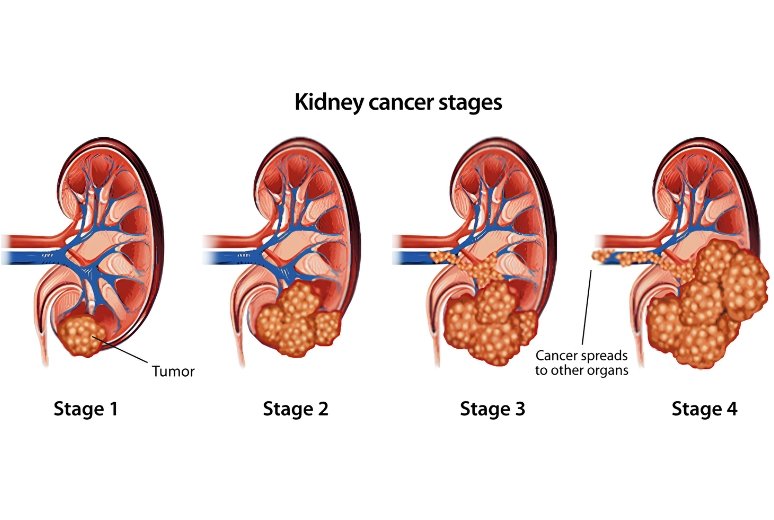
Stage 1 - Localised and Highly Treatable
With Stage 1, the tumour is smaller than 7 centimetres, and it is localised in the kidney, not having affected any other tissues or lymph nodes.
Most of the people with cancer at this stage do not experience any symptoms. This type of cancer may be found by chance when doctors run a test for something else.
At Stage 1, chances of recovery are really good. Kidney cancers at early stages, namely at Stages 1 and 2, usually have a higher than 90% survival rate. The most common treatment includes surgery to remove the cancer or the affected kidney tissue.
Key message: Early diagnosis at Stage 1 saves lives from kidney cancer.
Stage 2 - Still Within the Kidney, But Larger
A Stage 2 kidney cancer tumour is larger — more than 7 centimetres — but it is still confined within the kidney and has not moved into surrounding tissue or lymph nodes.
Symptoms may still be absent, though some people begin to notice blood in their urine, a dull backache, or fatigue. These signs are easy to dismiss as something minor — which is why they are often ignored.
Treatment at this stage is still very effective. Surgery remains the primary approach, and survival rates continue to be very encouraging. Early detection here still gives patients a strong fighting chance.
Stage 3 - Spread Beyond the Kidney
By Stage 3, cancer will have spread beyond the kidney by invading adjacent structures like large blood vessels adjacent to the kidney and fatty tissues around it. Or it may start involving regional lymph nodes. The cancer cells haven’t spread to distant organs yet.
Symptoms are likely at this stage. Blood in the urine, pain in the lower back or side, weight loss for no apparent reason, and fatigue are common. By now, treatment is more extensive than ever and usually involves surgery along with other treatments like immunotherapy.
The chances for success vary based on how much the cancer has spread locally, but diagnosis at this stage isn’t all bad news.
Stage 4 - Advanced and Requiring Specialised Care
Stage 4 means the cancer has spread beyond the kidney to other organs — such as the lungs, liver, bones, or brain. This is called metastatic kidney cancer.
This stage is the most challenging to treat. However, it is important to understand that Stage 4 is not the end of options. Advanced kidney cancers demand a multimodal approach for their efficient management — including targeted therapy, immunotherapy, and in some cases, surgery to remove tumours that have spread. Modern medicine has made significant progress in managing advanced kidney cancer, and many patients benefit from treatments that slow the disease, reduce symptoms, and extend life meaningfully.
The focus at this stage is on personalised, expert care — finding the right combination of treatments for each patient’s situation.
Warning Signs to Never Ignore
Regardless of the stage, these are the symptoms that should prompt an immediate visit to a specialist:
- Blood in the urine — even once, even if it goes away
- A lump or swelling in the back or abdomen
- Persistent pain below the ribs on one side
- Unexplained weight loss or loss of appetite
- Fatigue that doesn’t improve with rest
- Fever that keeps returning without a clear cause
None of these symptoms on their own confirms kidney cancer. But any one of them warrants a proper medical evaluation — without delay.
Expert Care Makes All the Difference
This is just the beginning, though. The next steps, like treatment, surgery, and post-treatment care, require having the right specialist on your team. Dr. Aditya Parikh is a uro-oncologist and robotic surgeon who has undergone extensive fellowship training in London. His specialization lies in the diagnosis and treatment of urological cancers, which include kidney cancer.
With his advanced training in using robotic surgery and minimally invasive procedures, he provides accurate and targeted treatment to help patients recover quickly and without complications. Advanced Kidney Cancer Treatment in Ahmedabad requires consulting with a specialist trained for such a condition.