

What Are the Chances of Success with IVF Treatment?
Introduction
If you and your partner are considering IVF treatment, one of the very first questions that comes to mind is: “Will it actually work for us?” It’s one of the most human questions to ask, and it deserves an honest, clear answer.
The truth is, IVF success is not a fixed number. It depends on several factors unique to each couple. Understanding what influences those chances can help you go into this journey feeling informed, prepared, and realistic without losing hope.
What Is IVF, in Simple Terms?
IVF, or In Vitro Fertilisation, is a process where eggs are retrieved from the woman’s ovaries, fertilised with sperm in a lab, and the resulting embryo is then placed into the uterus. It’s one of the most advanced and widely used fertility treatments available today and has helped millions of families worldwide.
The entire process, from preparation to embryo transfer, typically takes three to four weeks per cycle.
So, What Are the Actual Success Rates?
This is where most people want a simple answer, but the reality is a little more layered. IVF success rates are most strongly tied to the woman’s age, because age directly affects egg quality and quantity.
Here’s a general picture:
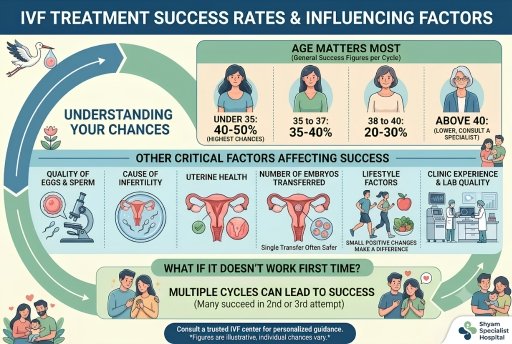
- Under 35: Success rates are typically the highest, often ranging between 40 to 50 per cent per cycle
- 35 to 37: Rates begin to gradually decrease, usually around 35 to 40 per cent
- 38 to 40: Success rates fall further, typically between 20 to 30 per cent
- Above 40: Success rates are lower, though IVF treatment can still be an option with specialist guidance
These are general figures. Your individual success rate at a trusted IVF center will depend on your specific medical profile, not just age alone.
What Else Affects IVF Success?
Age is important, but it’s not the only factor. Several other things influence how likely IVF treatment is to succeed:
Quality of eggs and sperm: Healthy, good-quality eggs and sperm significantly increase the chances of a successful embryo. Sperm health is often underestimated but plays an equally important role.
Cause of infertility: Some conditions respond better to IVF than others. For example, blocked fallopian tubes or male factor infertility tend to have more predictable outcomes with IVF treatment compared to unexplained Infertility Management.
Uterine health: A healthy uterine lining is essential for an embryo to implant successfully. Issues like fibroids, polyps, or an unusually shaped uterus can affect outcomes and may need to be addressed before starting IVF.
Number of embryos transferred: Transferring more than one embryo can increase success chances slightly but also raises the likelihood of a multiple pregnancy. Most specialists today lean towards single embryo transfers for safety reasons.
Lifestyle factors: Smoking, being significantly overweight or underweight, high stress levels, and poor nutrition can all quietly affect IVF outcomes. Small positive changes in lifestyle before starting treatment do make a difference.
Clinic experience and lab quality: The expertise of your IVF center and the quality of the embryology lab can have a meaningful impact on results. This is why choosing the right place matters.
What If the First Cycle Doesn't Work?
This is something every couple going through IVF needs to be mentally prepared for. A single cycle may not always result in pregnancy and that’s not a sign that it will never work. Many couples succeed in their second or third attempt.
Your fertility specialist will review what happened in the first cycle and adjust the approach accordingly. Each cycle gives the doctor more information to work with.
How Many Cycles Might Be Needed?
There’s no universal answer. Some couples get pregnant on the first try. Others need two or three cycles. Your doctor at a reputed IVF center will be able to give you a realistic picture based on your diagnostic reports and history.
Cumulative success rates, meaning your chances across multiple cycles, are considerably higher than a single-cycle figure.
Get Guidance from Someone Who Truly Understands Your Case
Reading success statistics online only tells part of the story. What actually matters is what those numbers mean for you specifically, and that’s a conversation only a qualified specialist can have with you.
At Shyam Specialist Hospital, we help couples navigate this journey with compassion, clarity, and clinical precision.
Dr. Shailee Bhandari Parikh and her team at this trusted IVF center believe that every couple deserves personalised care, not just a standard protocol. If you’re exploring IVF treatment and want to understand your real chances based on your health profile, reach out and book a consultation today.