

What Is IVF and How Does the IVF Process Work?
Introduction
If you’ve been trying to conceive for a while without success, chances are someone has already mentioned IVF to you. It’s a term that gets thrown around a lot, but not everyone actually knows what it involves, how long it takes, or what to expect once you decide to go ahead with it.
What Exactly Is IVF?
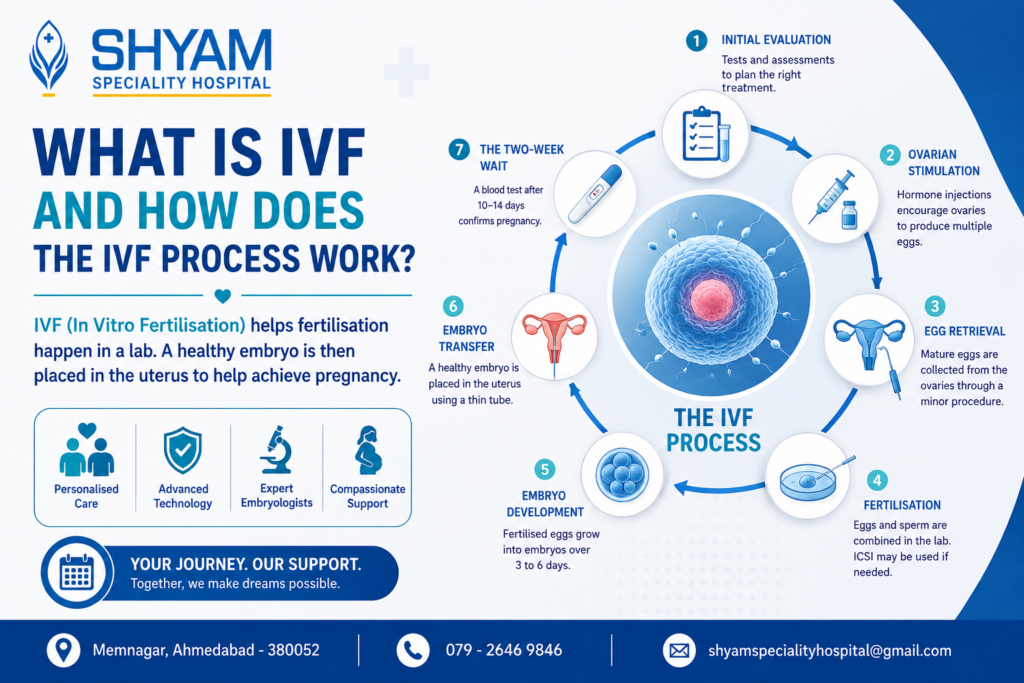
IVF stands for In Vitro Fertilisation. In simple words, it means fertilisation happens outside the body, in a lab, instead of inside the uterus the way it naturally would.
An egg and a sperm are combined in a controlled lab setting to form an embryo. Once that embryo grows to a healthy stage, it’s placed back into the uterus, where it can implant and hopefully develop into a pregnancy. It sounds technical, but the idea behind it is fairly straightforward: IVF simply helps the process along in cases where natural conception isn’t happening on its own.
Who Usually Needs IVF?
IVF isn’t only for one specific situation. It’s commonly recommended for:
- Blocked or damaged fallopian tubes
- Low sperm count or poor sperm movement
- Ovulation disorders
- Unexplained infertility, where no clear cause is found
- Age-related fertility decline
- Couples who’ve tried other fertility treatments without success
If you’ve been trying for over a year (or six months, if the woman is over 35) without conceiving, it’s worth having a fertility evaluation rather than waiting longer.
The IVF Process, Broken Down
Here’s what the journey typically looks like, stage by stage.
- Initial Evaluation Before anything begins, both partners usually go through basic tests blood work, ultrasounds, and a semen analysis, to understand what’s really going on and to plan the right approach.
- Ovarian Stimulation Instead of relying on the single egg the body releases naturally each month, hormone injections are used for about 8 to 12 days to encourage the ovaries to produce multiple eggs. More eggs generally mean better chances of getting a healthy embryo.
- Egg Retrieval Once the eggs are mature, a minor procedure, done under light sedation, is used to collect them directly from the ovaries. It usually takes about 20 to 30 minutes, and most people go home the same day.
- Fertilisation In the lab, the retrieved eggs are combined with sperm. Sometimes a single sperm is directly injected into an egg (a technique called ICSI) if sperm quality is a concern.
- Embryo Development Over the next 3 to 6 days, fertilised eggs are monitored as they grow into embryos. Not every fertilised egg develops into a strong, transferable embryo, which is completely normal.
- Embryo Transfer A healthy embryo is placed into the uterus using a thin, flexible tube. This is a quick, generally painless procedure that doesn’t require anaesthesia.
- The Two-Week Wait This is often the hardest part emotionally. About 10 to 14 days after transfer, a blood test confirms whether implantation was successful.
What Are the Success Chances?
This is where honesty matters more than optimism. IVF success depends heavily on:
- The woman’s age (younger age generally means higher success rates)
- The underlying cause of infertility
- Egg and sperm quality
- The expertise of the fertility team and lab conditions
It’s worth knowing that IVF doesn’t always work on the first attempt, and that’s not a reflection of anything being “wrong” with you, it’s simply how the process works for many couples.
Is IVF Painful or Risky?
Most of the process involves mild discomfort rather than significant pain, injection-site soreness, some bloating, or mild cramping after retrieval. Serious complications are uncommon, especially when the process is closely monitored by an experienced team.
Finding the Right Support in Ahmedabad
Going through IVF treatment in Ahmedabad can feel overwhelming at first, but having a team that explains each step clearly, monitors your response to medication carefully, and adjusts the plan to your specific situation makes a real difference to the experience.
At Shyam Speciality Hospital, Dr. Shailee Bhandari Parikh works closely with couples through every stage of the IVF process, from the first evaluation to the final embryo transfer, ensuring the approach is personalised rather than generic.
Taking the Next Step
IVF is not a last resort or something to feel apprehensive about; it’s simply a well-established medical path that has helped countless couples build their families. Understanding each step ahead of time can take away a lot of the uncertainty and help you feel more in control of the process.