

When Should You Worry About Your Menstrual Cycle?
Introduction
Periods are one of those things everyone experiences differently, yet nobody really talks about openly. Some months are light and predictable; others feel completely off. So how do you know when your cycle is just “being you,” and when it’s actually trying to tell you something?
What Does a "Normal" Cycle Actually Look Like?
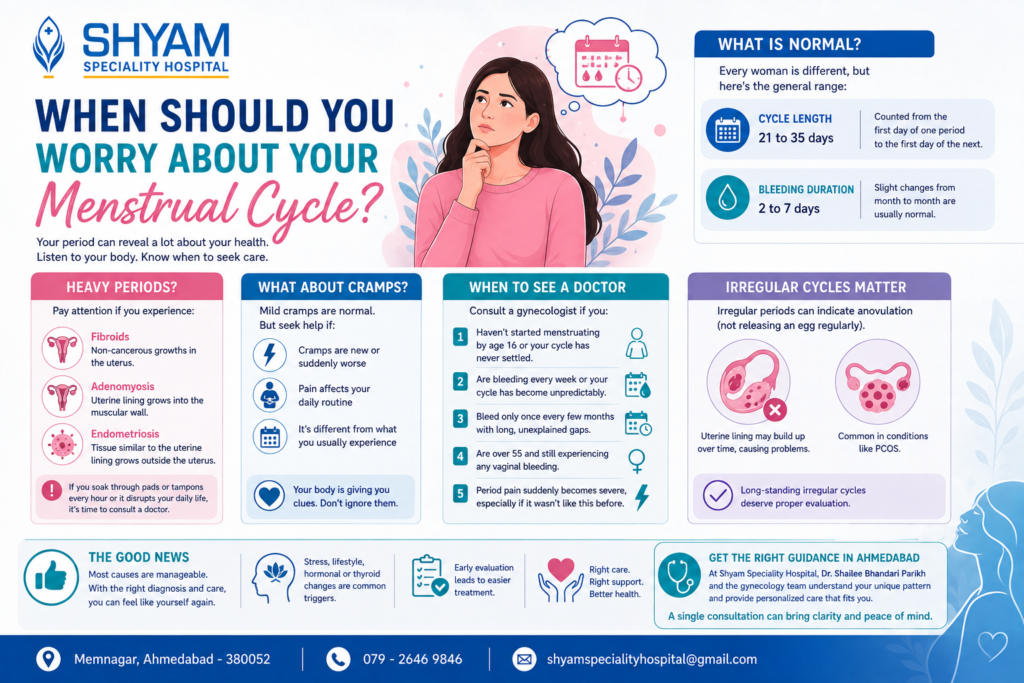
There’s no single perfect number here, but doctors generally look at two things: how long your cycle is and how long you bleed.
- Cycle length: Counted from the first day of one period to the first day of the next, a typical cycle falls anywhere between 21 and 35 days.
- Bleeding duration: Most periods last between two and seven days.
If your cycle sits somewhere in this range, even if it’s not exactly the same every single month, that’s usually considered healthy. Your body isn’t a clock; a little variation from month to month is completely normal.
Are Heavy Periods Something to Worry About?
Not automatically, but they’re worth paying attention to. Heavy bleeding can sometimes be linked to:
- Fibroids — non-cancerous growths in the uterus that can make periods heavier or longer than usual.
- Adenomyosis — a condition where the uterine lining grows into the muscular wall of the uterus.
- Endometriosis — a condition where tissue similar to the uterine lining grows outside the uterus, often causing pain along with heavy flow.
The key thing to watch for isn’t just “heavy” on its own, but a sudden change from what’s normal for you. If you’re soaking through pads or tampons every hour, or your period is disrupting your daily life, that’s worth discussing with a doctor.
What About Cramps?
Mild period cramps are common and, honestly, expected for most women. But there’s a difference between “the usual discomfort” and something new or worsening.
If cramps suddenly show up after years of pain-free periods, or if they’ve become severe enough to affect your daily routine, that’s a signal your body is asking for attention,n not something to just push through.
When Should You Actually See a Doctor?
Here’s a simple way to think about it. You should consider seeing a gynecologist if:
- You haven’t started menstruating by age 16, or your cycle has never settled into a fairly regular pattern.
- You’re bleeding every week, or your cycle has become unpredictable in a way that feels new.
- You’re bleeding only once every few months, with long, unexplained gaps.
- You’re over 55 and still experiencing any vaginal bleeding.
- Your period pain suddenly becomes severe, especially if it wasn’t like this before.
None of these automatically mean something serious is going on. But they’re signals that deserve a proper check-up rather than being ignored.
Why Irregular Cycles Deserve Attention, Not Just Dismissal
Here’s something a lot of people don’t realise: irregular periods aren’t just an inconvenience; they can sometimes point to anovulation, meaning your body isn’t releasing an egg regularly.
When ovulation doesn’t happen consistently, the uterine lining doesn’t shed the way it’s meant to. Over time, this can lead to the lining building up more than it should, which is why long-standing irregular cycles are worth investigating rather than simply managing around.
This is particularly relevant for conditions like PCOS (Polycystic Ovarian Syndrome), where irregular ovulation is common and long-term monitoring genuinely matters.
The Good News: Most Causes Are Manageable
It’s easy to jump to worst-case scenarios, but the reality is that most menstrual irregularities have straightforward explanations: stress, thyroid changes, weight fluctuations, or hormonal shifts. Once identified, they’re usually very manageable with the right guidance.
The goal isn’t to alarm you every time your cycle shifts by a few days. It’s to help you recognise the difference between “my body doing its own thing” and “this needs a second look.”
Getting the Right Guidance in Ahmedabad
If your cycle has been consistently unpredictable, unusually painful, or simply different from what feels normal for you, it’s worth speaking to a gynecologist in Ahmedabad rather than waiting it out.
At Shyam Speciality Hospital, Dr. Shailee Bhandari Parikh and the gynecology team focus on understanding your specific pattern first, rather than applying a generic checklist, so the guidance you get actually fits your situation.
A single consultation can often clear up months of uncertainty, and that peace of mind alone is worth the visit.
Your menstrual cycle is one of the clearest windows into your overall health, so it’s worth paying attention to rather than brushing it aside. Most changes are harmless, but knowing the signs that call for a doctor’s visit means you’ll never have to wonder for too long. When in doubt, ask; that’s always the safer, simpler choice.


